Saturday, May 3, 2014

Process


Have you ever started a painting with the thought “where on earth am I going with it?”
Lately that has been part of every painting I make. No finished image in mind, just dive into the process without over thinking it.

So I made this little painting of 12x12" and recorded the process of creating it.


I break everything into steps that makes sense to me. I often change my mind.


Thursday, December 26, 2013

Practice in Repetition

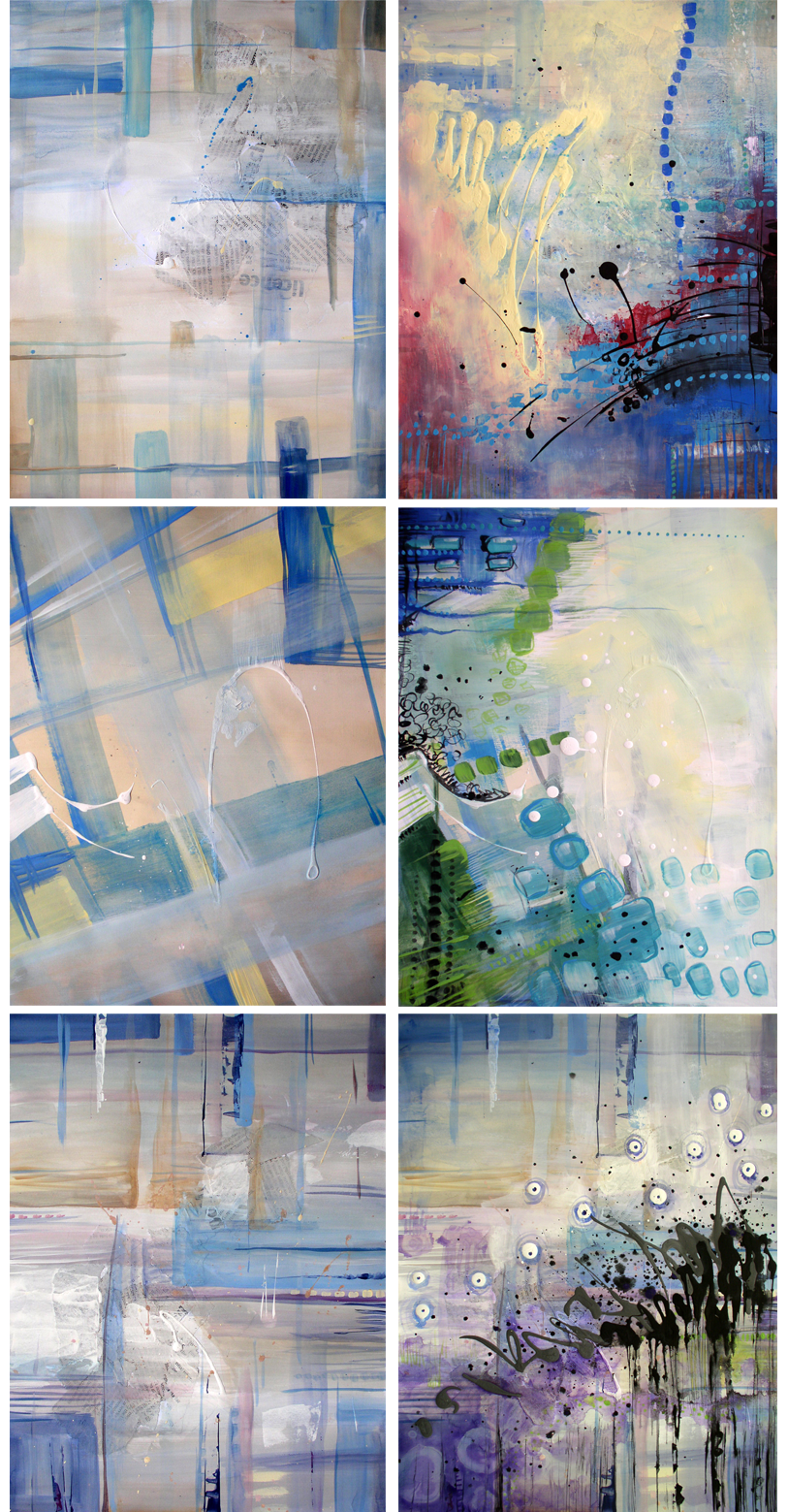
A few days ago I pushed myself to paint as much as I can in one day. Something repetitive but every time trying different color schemes and compositions.

                                                                                        Click for bigger view..

Doing something over and over again is a great way to master the used technique or really learn the subject matter.
One of the more famous examples of repetition was Van Gogh's haystacks. He painted them in different time of the day, different weathers, different seasons, different compositions and slight change in styles.

For me it was interesting to feel my imagination stretch, visualize what the end result might be while just picking the colors, and of course sense of accomplishment for doing so much in so little time.
I feel I'm getting better at achieving the playfulness of the brush strokes that I want, and I now have ideas that can be used for bigger pieces.

All these pieces named Star Dusts, they are letter size (8.5x11” / 22x28 cm) on thick paper, and are available for purchase for only 50 USD (shipping included).
If you are interested, you can message me here or on Facebook.

Happy Holidays! :)

Friday, October 25, 2013

Artistic Block

A couple of days ago I was asked “What do you do when you're blocked? “ as one of the questions I had to answer for the upcoming book "A World of Artist Journal Pages" for which my art journal was chosen to be featured in.

It really got me thinking of what a block is and analyze my reaction to it and the end results.
I must say, I gained a whole new perspective on the matter!

It is important to note that this approach won't be as effective for everyone.. but as a professional artist, I just can't afford to sit doing nothing and dwell in it. Keep in mind, there is a difference between artistic block and a need to take a break for what ever reason.

Artistic block for me usually starts as lack of desire to do anything.. then morphs into more of a hunger to do something but not knowing what.. and ends with me doing something interesting and new!
I came to the conclusion that it is a very important part in artistic growth. It symbolizes the fact that I'm bored with what I'm doing and that it's time to move on and open a new page. Growth doesn't always come easy, just need to persevere.

Most of the time I just do what I want to do.. and not that much of what I need to do - practice! The trick is to take that moment of frustration and force yourself to do something.. anything!
Waiting for the block to just go away, sadly isn't that effective and it can take ages while your skills slowly begin to rust.. You need to take control and get rid of it!

Here are a few things that you can do:
  • Try new style
  • Try new medium
  • Try new tools
  • Make lists of interesting things you want to try and when you are blocked, start checking those things off.
  • Copy something that you like
  • Think outside of the box – paint the music/sound/smell/weather..
  • Take an art class – You'll have a personal commitment to do the assignments and you'll be surrounded by other creative and inspirational artists.

Artistic block is natural and happens to everyone, it is okay and by no means a reason to get stressed over.

Monday, September 16, 2013

First Stage Frustration

I noticed many people go through a frustrating confusion at the first stages of creating something.. No matter what the subject matter is, there is always something that isn't perfect.

But remember, good things don't come easy! Stick around and see what it can grow into.

This is mostly true for artists that work in a similar way like I do... I dive into the piece with no clear direction to see what will happen. I love struggling through the visuals till I get it all solved to the point that I find it complete.
It might sound like a cliche, but my paintings are a journey for me. I paint for the process of it, not so much for the end result.

I have my moments when nothing works, pushing through it sometimes makes it even worse... but unless I give up, at the end it is all worth it.

Here is an example of my painting “Oasis of Serenity” that is now displayed at UGM's Rotating Gallery. My only clear direction was that I wanted to make something both calm and uplifting.


1st photo was just to point out the texture that I had to work with.
2nd photo is when I got the feeling that I have no idea where I'm going with it.
3rd photo I found the color that seems fitting and the rest went as smooth as butter.
4th photo is the end result.

My advice is not to treat your piece as something precious, it is ok to fail. If you learned anything from it – it was worth it. Mistakes can turn into something amazing!
It is hard at first, just don't ever give up!

Wednesday, July 31, 2013

Let your work rest

We all have surge of inspiration or just desire to create sometimes, many pieces are created easily, without any problems or delays... but, some pieces just don't work. At the point when we feel frustrated, it can be very beneficial to just leave it alone for a while.

Few days ago I was going through some of my old practice paintings that I've done about half a year ago. It was easy to see how my style changed since then and I got many ideas on how I can change them, make them better.


Even thought it looks completely different, I did preserve some of the elements I liked in the under layers.
Sometimes I also look at my painting as I'm working on it, in my eyes it's not finished, but I simply don't know what else can I do to it. I had few pieces that I left for a while, and was working on them through out a long period of time, a touch here, and a touch there... Now, those paintings became my favorites.

When nothing works... painting over it and reusing it is also a great idea!

Saturday, July 20, 2013

What being an artist is all about

Here is a very short summary of quotes from the letters of Reiner Maria Rilke to a young poet (1903):

Your work must be independent from others' work.
You must not compare yourself to others.
No one can help you. You can only help yourself.
Criticism leads to misunderstandings and defeatism.
Work from the necessity and your compulsion to do it.
Work on what you know and what you are sure you love.
Don't observe yourself too closely, just let it happen.
Don't let yourself be controlled by too much irony.
Live in and love the activity of your work.
Be free of thoughts of sin, guilt and misgiving.
Be touched by the beautiful anxiety of life.
Be patient with the unresolved in your heart.
Try to be in love with the questions themselves.
Love your solitude and try to sing with its pain.
Be gentle to all of those who stay behind.
Your inner self is worth your entire concentration.
Allow your art to make extraordinary demands on you.
Bear your sadness with greater trust than your joy.
Do not persecute yourself with how things are going.
It's good to be solitary, because solitude is difficult.
It's good to love, because love is difficult.
You are not a prisoner of anything or anyone.

Rainer Maria Rilke (1875 – 1926) was born in Czechoslovakia and died in Switzerland. Considered the greatest modern poet in the German language, Rilke counseled the young poet over a period of five years. No evidence exists that they ever met.

There might be things that we will disagree with, but to some extent, I feel that they are true. It's important to learn from others, but we need to be ourselves first, and what we create, needs to be our own.
I find it amazing that we can learn till this day so much from advices that were given more than a century ago.

Friday, May 3, 2013

Photographing Art Work

Taking a traditional painting and trying to turn it into a well presented digital image can be tricky. To get to the best representation there is a need to get a good photo of it and do the right editorial work.

In this blog, I'll cover the photography part.

Here are 2 examples (click to view):


Window – It's better to take photos outside, but it was cold during the winter, so I took some photos of my paintings near a window. The biggest problem is that there is a gradient of light, lighter by the window, darker further away.

Shade – Taken outside in the shade. I personally believe that is the closest to the original look of the painting.

Sunlight – Direct sunlight fills the painting with very bright colors, sometimes brighter than the actual colors. If the painting has glossy areas, they will shiny. If there is some texture in the painting, it will cast shadows.

Flash – A big no no. The focus of the light usually in the center, darker around. Glossy areas pick up most of the light and make the painting look as if it is covered in plastic food wrap.

No flash – In rather dark place it will be really hard to get the focus right, most of the times the photos come out very blurry and with a slight color change.

Room light – Most of the room lights have a touch of yellow in them, the yellow can be clearly seen in the photo.

Additional tips:
  1. Take photos of your paintings before you varnish them, the gloss is very often hard to deal with.
  2. The best time of the day to take photos is around noon, the later it gets, the more yellow – orange the light becomes.
  3. Some paintings photograph better in direct sunlight (if there is no gloss or texture), but from my personal experience, the closest colors to my paintings, are in the photos taken in the shade.
  4. Take at least 3 photos, there is always a chance for something to go wrong. Look through all the photos and pick the best one.
  5. The easiest way to know that the light source is good enough is when your camera is set on auto (flash when needed, no flash when not needed) and it doesn't flash.

Your work deserves a good representation!

I hope it helped..